
The summer before my senior year at Cal Poly, I did undergraduate research in graph theory + dynamic network models. It turned into a peer-reviewed paper on how you can represent certain rational Pick functions using graph-based models (via Cauchy transforms and tools like Schur complements). I remember thinking how strange this type of math was: it looks abstract at first, but it's extremely structural underneath. Once you build the model, you can literally see how changing the graph changes the function's behavior.
The published paper is here: https://www.sciencedirect.com/science/article/pii/S0024379525004525?via%3Dihub
the problem (in plain English)
We wanted a clean, concrete way to understand and represent a specific class of functions (Pick functions) using objects you can reason about visually and structurally (graphs). Instead of treating the function like a mysterious black box, the goal was to give it a graph "skeleton" that makes its behavior more interpretable and easier to analyze.
what i worked on
- Researched the underlying theory around graph-based models and how they connect to rational Pick functions
- Helped build and validate the framework connecting graphs ↔ function representations
- Worked through the math tools that make the connection precise (including Cauchy transforms and Schur complements)
- Contributed to writing and polishing the final paper, with an emphasis on clarity and structure
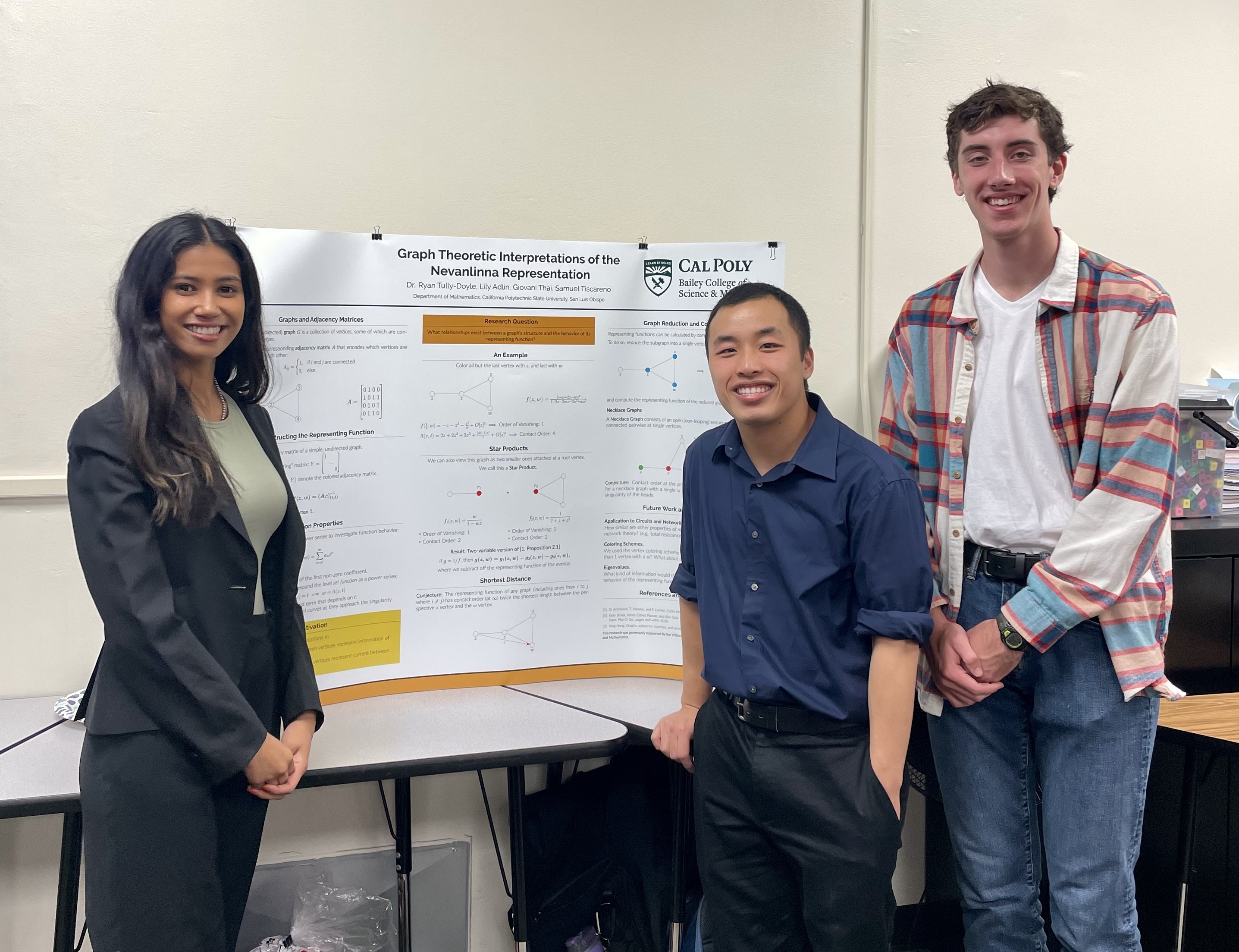
my research team
what made it interesting (my favorite part)
A lot of advanced math can feel like it's floating in space. This didn't. The structure mattered. The "shape" of the graph actually does something to the function. Once you internalize that, the work becomes less about memorizing symbols and more about understanding how the system behaves when you tweak the underlying structure.
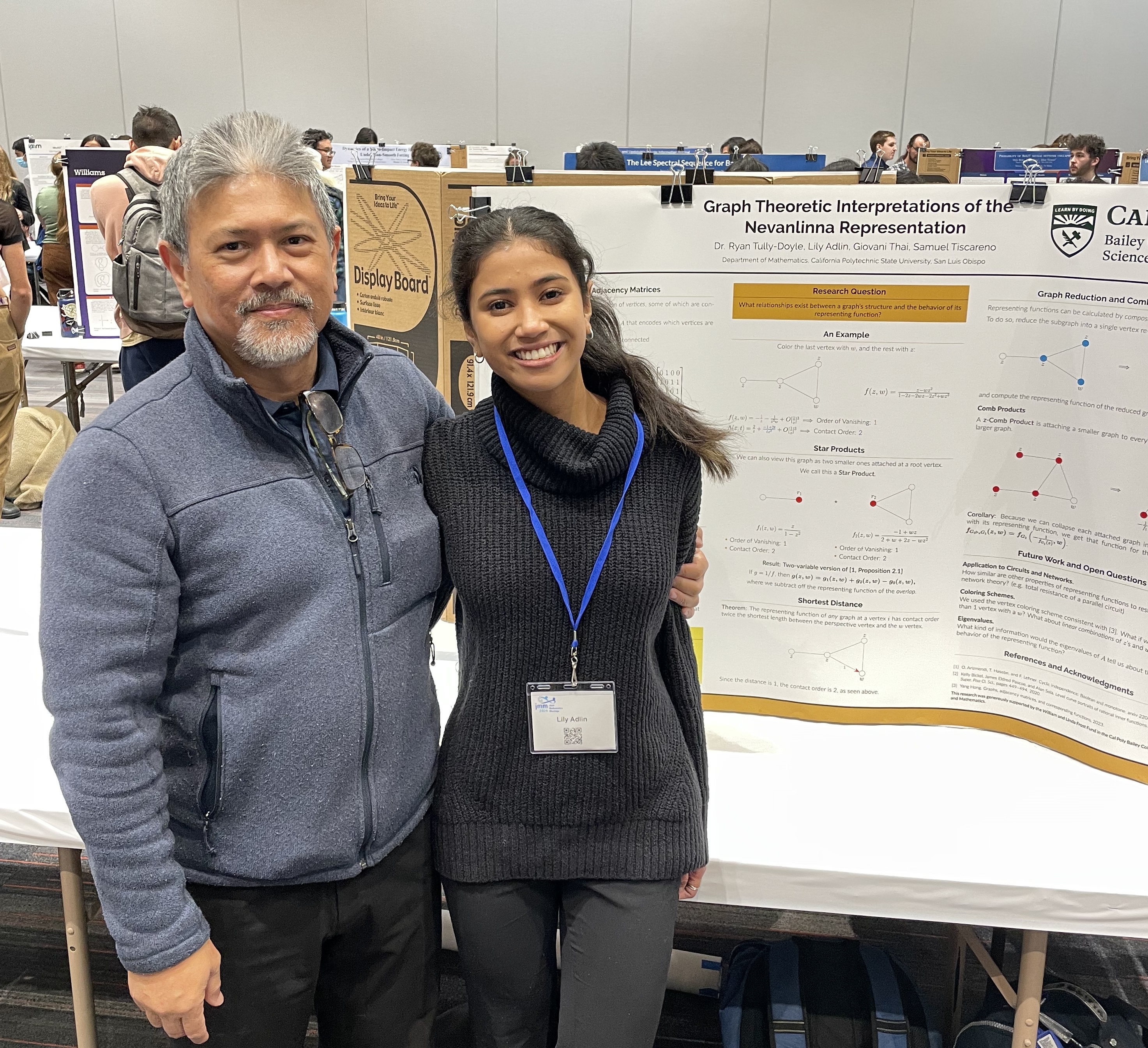
my dad and I at JMM 2024
communication + presenting
I presented the work four times (math department talk, university-wide symposium, Frost Undergraduate Research, and Joint Mathematics Meetings). That ended up being a crash course in explaining technical ideas without losing the plot. It forced me to focus on the "why," not just the derivations, and it sharpened how I communicate complex work to different audiences. Even got a compliment from the dean on my presentation skills ;)

me and my math girlies!